publications
publications by year in reversed chronological order.
2026
-
 New indirect searches of dark matter with the GAPS experimentLuca Volpicelli , and GAPS CollaborationIl Nuovo Cimento C, Jan 2026
The General AntiParticle Spectrometer (GAPS) is a long-duration balloon-borne experiment designed to detect low-energy cosmic-ray antinuclei (below approximately 0.25 GeV/n) as potential indirect signatures of dark matter. Unlike traditional detection methods relying, for example, on magnetic spectrometers, GAPS employs a novel approach based on the formation, de-excitation, and decay of exotic atoms, enabling the identification of antinuclei without the use of a magnet. The mission will investigate the low-energy sector of the cosmic-ray spectrum that has remained largely unexplored, allowing for a critical test of theoretical models predicting the flux of low-energy antideuterons. In addition, GAPS is expected to achieve unprecedented sensitivity to cosmic antiprotons and to provide leading sensitivity to low-energy antihelium nuclei in cosmic radiation. During its pre-flight campaign in Antarctica (November–December 2024), the apparatus performed several muon runs for both scientific and calibration purposes. Performance studies related to the detection of this particle population at sea level are currently ongoing ahead of the scheduled launch during the 2025–2026 season.
@article{volpicelli_gaps_dm_2026, title = {New indirect searches of dark matter with the GAPS experiment}, author = {Volpicelli, Luca and on behalf of the GAPS Collaboration}, year = {2026}, month = jan, journal = {Il Nuovo Cimento C}, volume = {49}, number = {1--2}, pages = {1--6}, issn = {0390-5551}, doi = {10.1393/ncc/i2026-26006-7}, url = {https://doi.org/10.1393/ncc/i2026-26006-7}, urldate = {2026-02-03}, langid = {english}, keywords = {dark matter, cosmic rays, antinuclei, GAPS experiment, indirect detection}, dimensions = {true} } -
 Design, testing and calibration of the GAPS experiment Si(Li) tracker readout ASIC: from the first flight campaign toward the second mission upgradeLuca GhislottiUniversità degli Studi di Bergamo , Jan 2026
The General Antiparticle Spectrometer (GAPS) is a balloon-borne experiment designed to perform three long-duration flights from Antarctica to search for low-energy cosmic antinuclei, in particular antideuterons, as an indirect probe of dark matter. Its detection method is based on the formation and decay of exotic atoms, identified through the emission of characteristic X-rays and subsequent annihilation into secondary particles. At the core of the instrument is the silicon tracker, composed of lithium-drifted silicon detectors operated at −40 °C and read out by a custom application-specific integrated circuit (ASIC), SLIDER32, implemented in a 180 nm CMOS technology. This thesis reports on the integration, calibration, and validation of the SLIDER32-based tracker readout electronics. Laboratory characterization of a single tracker module with an Americium-241 source and cosmic muons was complemented by calibration and testing of the full tracker in its flight configuration, leading to the first X-ray spectrum acquisition from a Cadmium-109 source. These activities formed part of the integration and testing phase for the first flight, culminating in full instrument assembly and validation during the 2024 Antarctic campaign. Building on this experience, the work presents the design and characterization of a new prototype integrated circuit conceived as an upgrade to SLIDER32: the ANTARES4 chip, fabricated in 65 nm CMOS technology. The device integrates eight analog channels up to the shaping stage and implements dynamic signal compression techniques based on dynamic-threshold MOS transistors, together with an improved detector leakage current compensation circuit at the preamplifier input. Laboratory characterization provides an initial validation of these design choices, laying the foundations for the next-generation tracker readout system to be adopted in the second flight of the experiment.
@phdthesis{ghislotti_phd_2026, title = {Design, testing and calibration of the GAPS experiment Si(Li) tracker readout ASIC: from the first flight campaign toward the second mission upgrade}, shorttitle = {Design, testing and calibration of the GAPS experiment Si(Li) tracker readout ASIC}, author = {Ghislotti, Luca}, year = {2026}, month = jan, school = {Università degli Studi di Bergamo}, doi = {10.13122/ghislotti-luca_phd2026-01-28}, urldate = {2026-02-19}, langid = {english}, keywords = {GAPS experiment, Si(Li) detectors, readout ASIC, SLIDER32, ANTARES4, 65 nm CMOS, dark matter, balloon-borne experiments}, dimensions = {true} } -
 A 65 nm CMOS readout ASIC with dynamic signal compression for balloon-borne spectrometry applicationsLuca Ghislotti, Paolo Lazzaroni , Massimo Manghisoni , Lodovico Ratti , Valerio Re , and Elisa RiceputiIn Proceedings of SIE 2025 , Jan 2026
Balloon-borne and spaceborne spectrometers require front-end electronics capable of achieving a wide dynamic range and high energy resolution while operating under strict thermal and power constraints. ANTARES4 is a prototype readout application-specific integrated circuit (ASIC) fabricated in a commercial 65 nm CMOS technology for the readout of silicon detectors in high-energy astrophysics applications. The chip integrates eight fully analog channels, each composed of a charge-sensitive amplifier followed by a semi-Gaussian CR–RC shaper with selectable peaking times ranging from 0.2 μs to 1.6 μs for signal-to-noise optimization. The feedback capacitor of the charge-sensitive amplifier is implemented using MOS devices with voltage-dependent capacitance, enabling dynamic signal compression and bilinear input–output behavior with differentiated gain for low-energy X-rays and high-energy charged particles. Four feedback configurations, including both n-type and p-type MOS capacitors with matched gate areas, are implemented for direct performance comparison. The circuit dissipates approximately 3.5 mW per channel, remaining within the target power budget, and achieves simulated energy resolutions of 3.5 keV FWHM with a detector capacitance of 40 pF. The input dynamic range extends over four decades, from 10 keV to 100 MeV. The chip has been submitted for fabrication, and a dedicated test board has been developed for characterization at room temperature and down to −40 °C.
@inproceedings{ghislotti_antares4_sie2026, title = {A 65 nm CMOS readout ASIC with dynamic signal compression for balloon-borne spectrometry applications}, booktitle = {Proceedings of SIE 2025}, author = {Ghislotti, Luca and Lazzaroni, Paolo and Manghisoni, Massimo and Ratti, Lodovico and Re, Valerio and Riceputi, Elisa}, editor = {Pavan, Paolo and Campopiano, Stefania}, year = {2026}, pages = {157--164}, publisher = {Springer Nature Switzerland}, address = {Cham}, doi = {10.1007/978-3-032-17305-8_16}, isbn = {978-3-032-17305-8}, langid = {english}, keywords = {readout ASIC, dynamic signal compression, CMOS, charge-sensitive amplifier, Si(Li) detectors, balloon-borne experiments, GAPS experiment}, dimensions = {true} } -
 The General Antiparticle Spectrometer (GAPS) Antarctic balloon payloadThe GAPS CollaborationApr 2026
The General Antiparticle Spectrometer (GAPS) is an Antarctic stratospheric balloon mission designed to provide unprecedented sensitivity to low-energy (< 0.25 GeV/n) cosmic-ray antiprotons, antideuterons, and antihelium nuclei as signatures of dark matter. The distinctive GAPS particle identification technique relies on measuring the energy loss of an incoming antinucleus as it slows down and is captured into an exotic atom, followed by the detection of characteristic de-excitation X-rays and nuclear annihilation products. These measurements are performed using a tracker composed of more than 1000 custom silicon strip detectors and a plastic scintillator time-of-flight (TOF) system instrumenting more than 40 m². Together, these subsystems provide the velocity and energy resolution, stopping power, particle tracking, and X-ray identification required to distinguish rare antinucleus signals from the abundant positive-nucleus background within the constraints of a high-altitude balloon mission. A multi-loop capillary heat pipe system maintains the tracker operating temperature with substantial mass and power savings compared with conventional pumped cooling systems. The first GAPS science payload flew for 25 days during the 2025–2026 NASA Antarctic balloon campaign. This paper describes the design, integration, and commissioning of the payload prior to flight.
@misc{gaps_payload_2026, title = {The General Antiparticle Spectrometer (GAPS) Antarctic balloon payload}, author = {{The GAPS Collaboration}}, year = {2026}, month = apr, eprint = {2604.19830}, archiveprefix = {arXiv}, primaryclass = {astro-ph.IM}, publisher = {arXiv}, doi = {10.48550/arXiv.2604.19830}, urldate = {2026-04-24}, keywords = {GAPS experiment, balloon-borne experiments, dark matter, antinuclei, silicon strip detectors, time-of-flight systems, exotic atoms}, langid = {english}, dimensions = {true} } -
 A 65 nm CMOS readout channel based on a charge amplifier with DTMOS feedback for dynamic signal compressionLuca Ghislotti, Paolo Lazzaroni , Massimo Manghisoni , Valerio Re , Elisa Riceputi , and Lodovico RattiIEEE Transactions on Nuclear Science, Apr 2026
This paper presents the design and experimental characterization of a low-noise analog readout channel implemented in a commercial 65 nm CMOS technology. The circuit is intended for the readout of large-area silicon-strip detectors used in astroparticle physics tracker applications and is based on a charge-sensitive amplifier followed by a unipolar semi-Gaussian shaping filter. Dynamic signal compression is achieved by exploiting the nonlinear behavior of a dynamic-threshold MOS (DTMOS) capacitor in the amplifier feedback network, resulting in a gain that decreases with increasing input signal and enabling a wide dynamic range while preserving high resolution at low deposited charge. The amplifier also incorporates an enhanced Krummenacher feedback network that, through an additional bulk-controlled device, compensates detector leakage currents up to 200 nA. The design criteria and circuit architecture are described, with particular emphasis on the DTMOS feedback capacitor and the improved charge restoration network. Experimental results are presented to validate the proposed design and support the adopted architectural choices.
@article{ghislotti_tns_2026,
  title = {A 65 nm CMOS readout channel based on a charge amplifier with DTMOS feedback for dynamic signal compression},
  author = {Ghislotti, Luca and Lazzaroni, Paolo and Manghisoni, Massimo and Re, Valerio and Riceputi, Elisa and Ratti, Lodovico},
  year = {2026},
  journal = {IEEE Transactions on Nuclear Science},
  pages = {1--1},
  issn = {1558-1578},
  doi = {10.1109/TNS.2026.3700799},
  urldate = {2026-06-18},
  langid = {english},
  keywords = {charge-sensitive amplifier, DTMOS, dynamic signal compression, front-end electronics, silicon-strip detectors, 65 nm CMOS, Krummenacher feedback},
  dimensions = {true}
}


2025
-
 X-ray and particle detection with the Si(Li) tracker module of the GAPS experimentMassimo Manghisoni , Luca Ghislotti, Paolo Lazzaroni , Valerio Re , Elisa Riceputi , Lodovico Ratti , Lorenzo Fabris , Mirko Boezio , Gianluigi Zampa , and Mengjiao XiaoIEEE Transactions on Nuclear Science, Apr 2025
This work describes the architecture and the experimental results from the characterization of the lithium-drifted silicon (Si(Li)) detector module, which constitutes the building block of the tracker in the General Antiparticle Spectrometer (GAPS) experiment to search for dark matter. The instrument is designed for the identification of low-energy cosmic antinuclei (antiprotons, antideuterons and antihelium) to be performed during an Antarctic long-duration balloon flight scheduled for late 2025. The GAPS Si(Li) tracker, that is the core of the instrument, is the assembly of 252 modules, each comprised of four Si(Li) detectors and a full custom integrated circuit designed for detector readout and produced in a commercial 180 nm planar CMOS technology. A general overview of the detector module architecture and its components is provided, together with a description of the test setup and the experimental results obtained from the characterization of the low-noise analog readout channel. In order to verify the effective operation of the entire module, results concerning the detection of X-rays from a 241Am source and cosmic muons are also provided.
@article{manghisoni_xray_2025, title = {X-ray and particle detection with the Si(Li) tracker module of the GAPS experiment}, author = {Manghisoni, Massimo and Ghislotti, Luca and Lazzaroni, Paolo and Re, Valerio and Riceputi, Elisa and Ratti, Lodovico and Fabris, Lorenzo and Boezio, Mirko and Zampa, Gianluigi and Xiao, Mengjiao}, year = {2025}, journal = {IEEE Transactions on Nuclear Science}, pages = {1--1}, issn = {1558-1578}, doi = {10.1109/TNS.2025.3616408}, urldate = {2025-10-02}, keywords = {Antarctica, Clocks, CMOS, Detectors, dynamic signal compression, Energy resolution, Front-end, Instruments, Leakage currents, Low voltage, Low-noise, Sensors, Silicon, Strips}, dimensions = {true} } -
 Indirect search for dark matter with cosmic-ray antinuclei: the GAPS experimentAlessio Tiberio , and GAPS CollaborationJournal of Physics: Conference Series, Jul 2025
The General Antiparticle Spectrometer (GAPS) is a balloon-borne experiment designed to perform low-energy cosmic-ray antinuclei measurements to search for indirect signatures of dark matter annihilation or decay. A wide range of well-motivated dark matter models predicts antinuclei fluxes about two orders of magnitude above the expected astrophysical background below 250 MeV/n. The study of this unexplored low-energy region allows GAPS to achieve an unprecedented sensitivity for antideuteron and antihelium nuclei fluxes. GAPS will collect high statistics of low-energy antiprotons, extending the measurement of the antiproton spectrum to the unexplored region below 100 MeV. The GAPS experiment will perform three long-duration balloon flights over Antarctica, the first of which is planned for the 2024/2025 austral summer. The experimental apparatus consists of a Si(Li) tracker surrounded by a time-of-flight system made of plastic scintillator paddles. GAPS uses a novel identification technique based on the formation of an exotic atom and its de-excitation and decay. This contribution first illustrates the scientific potential of the GAPS experiment and its impact on indirect dark matter searches. It then describes the experimental apparatus and the detection technique exploited to identify antinuclei events. The expected sensitivity for antinuclei, based on detailed instrument simulations, is discussed. Finally, the status of payload integration and testing before the first flight is summarized.
@article{tiberio_indirect_2025, title = {Indirect search for dark matter with cosmic-ray antinuclei: the GAPS experiment}, shorttitle = {Indirect search for dark matter with cosmic-ray antinuclei}, author = {Tiberio, Alessio and on behalf of the GAPS Collaboration}, year = {2025}, month = jul, journal = {Journal of Physics: Conference Series}, volume = {3053}, number = {1}, pages = {012002}, publisher = {IOP Publishing}, issn = {1742-6596}, doi = {10.1088/1742-6596/3053/1/012002}, urldate = {2025-09-03}, language = {en}, dimensions = {true} } -
 GAPS detector cooling system: results from Antarctic ground testsKazutaka Aoyama , and GAPS CollaborationIn Proceedings of 39th International Cosmic Ray Conference — PoS(ICRC2025) , Sep 2025
The General Antiparticle Spectrometer (GAPS) experiment aims to elucidate the nature of dark matter by detecting low-energy antinuclei using a long-duration scientific balloon over Antarctica. The GAPS detector consists of a tracker made of lithium-drifted silicon detectors, surrounded by two layers of time-of-flight (TOF) plastic scintillators. To achieve an energy resolution of 4 keV FWHM in the 20–100 keV range, the silicon detectors are cooled to -40 °C using multi-loop capillary heat pipes (MCHPs), specifically developed for GAPS. The MCHPs transport heat from the detectors to a radiator attached to the payload’s sidewall. On the ground, the radiator is directly cooled by the Ground Cooling System (GCS) to enable detector testing. The GCS consists of a chiller, a cold plate, and insulating foam. GAPS completed successful instrument commissioning during the past Antarctic launch season. During this period, we conducted cooling tests to investigate the detector performance using the GCS. Unfortunately, GAPS was not able to launch in the past season due to weather. GAPS remains assembled at the LDB site and stands ready for its first scientific balloon flight in the austral summer of 2025–2026. This contribution presents the results of the ground tests conducted during the 2024/25 season, with a particular focus on the performance of the cooling system.
@incollection{aoyama_gaps_cooling_2025, title = {GAPS detector cooling system: results from Antarctic ground tests}, shorttitle = {GAPS detector cooling system}, booktitle = {Proceedings of 39th International Cosmic Ray Conference — PoS(ICRC2025)}, author = {Aoyama, Kazutaka and on behalf of the GAPS Collaboration}, year = {2025}, month = sep, volume = {501}, pages = {466}, publisher = {SISSA Medialab}, doi = {10.22323/1.501.0466}, urldate = {2025-10-03}, language = {en}, dimensions = {true} } -
 Antinuclei signatures of dark matter and the GAPS experimentKelsey Yee , and GAPS CollaborationIn Proceedings of 39th International Cosmic Ray Conference — PoS(ICRC2025) , Sep 2025
GAPS is a long-duration balloon experiment designed to measure the flux of low-energy (<0.25 GeV/n) cosmic antinuclei as signatures of dark matter. Many well-motivated theories for dark matter predict annihilation or decay channels that can produce final state hadrons which may include antiprotons and antineutrons that may coalesce to form low-energy antideuterons or antihelium. The background for complex antinuclei from standard astrophysical sources is orders of magnitude below the predicted flux from viable dark matter candidates at the low-energy range for which GAPS is optimized. The GAPS instrument is currently assembled in Antarctica and stands ready for its first flight during the December 2025/January 2026 launch season. This proceeding covers the anticipated science impact GAPS will have on the current landscape of cosmic antinuclei measurements as well as the instrument design and novel detection technique employed by the experiment.
@incollection{yee_antinuclei_2025, title = {Antinuclei signatures of dark matter and the GAPS experiment}, booktitle = {Proceedings of 39th International Cosmic Ray Conference — PoS(ICRC2025)}, author = {Yee, Kelsey and on behalf of the GAPS Collaboration}, year = {2025}, month = sep, volume = {501}, pages = {539}, publisher = {SISSA Medialab}, doi = {10.22323/1.501.0539}, urldate = {2025-10-03}, language = {en}, dimensions = {true} } -
 Design of the ANTARES4 readout ASIC for the second flight of the GAPS experiment: motivations and requirementsLuca Ghislotti, Paolo Lazzaroni , Massimo Manghisoni , and Elisa RiceputiOct 2025
The General Antiparticle Spectrometer (GAPS) is a balloon-borne experiment designed to search for low-energy cosmic-ray antinuclei as a potential indirect signature of dark matter. Over the course of at least three long-duration flights over Antarctica, it will explore the sub-250 MeV/n energy range with sensitivity to antideuterons and antihelium, while also extending antiproton measurements below 100 MeV. The instrument features a tracker built from more than one thousand lithium-drifted silicon detectors, each read out by a dedicated custom integrated circuit. With the first flight scheduled for the austral summer of 2025, a new prototype chip, ANTARES4, has been developed using a commercial 65 nm complementary metal-oxide semiconductor process for use in the second flight. It integrates eight independent analog channels, each incorporating a low-noise charge-sensitive amplifier with dynamic signal compression, a CR–RC shaping stage with eight selectable peaking times, and on-chip calibration circuitry. The charge-sensitive amplifier uses metal-oxide semiconductor feedback elements with voltage-dependent capacitance to support the wide input energy range from 10 keV to 100 MeV. Four alternative feedback implementations are included to compare performance and design trade-offs. Leakage current compensation up to 200 nA per detector strip is provided by a Krummenacher current-feedback network. This paper presents the design and architecture of ANTARES4, highlighting the motivations, design drivers, and performance requirements that guided its development.
@misc{ghislotti_design_2025, title = {Design of the ANTARES4 readout ASIC for the second flight of the GAPS experiment: motivations and requirements}, shorttitle = {Design of the ANTARES4 readout ASIC for the second flight of the GAPS experiment}, author = {Ghislotti, Luca and Lazzaroni, Paolo and Manghisoni, Massimo and Riceputi, Elisa}, year = {2025}, month = oct, number = {2025100181}, eprint = {2025100181}, publisher = {Preprints}, doi = {10.20944/preprints202510.0181.v1}, urldate = {2025-10-09}, archiveprefix = {Preprints}, language = {en}, keywords = {65 nm CMOS technology, antideuteron and antihelium search, balloon-borne cosmic-ray detection, charge-sensitive amplifier (CSA), dynamic signal compression, GAPS experiment, Krummenacher feedback, readout ASIC, Si(Li) strip detectors, spectrometer}, dimensions = {true} } -
 Design of the ANTARES4 readout ASIC for the second flight of the GAPS experiment: motivations and requirementsLuca Ghislotti, Paolo Lazzaroni , Massimo Manghisoni , and Elisa RiceputiParticles, Dec 2025
The General Antiparticle Spectrometer (GAPS) is a balloon-borne experiment designed to search for low-energy cosmic-ray antinuclei as a potential indirect signature of dark matter. Over the course of at least three long-duration flights over Antarctica, it will explore the sub-250 MeV/n energy range with sensitivity to antideuterons and antihelium, while also extending antiproton measurements below 100 MeV. The instrument features a tracker built from more than one thousand lithium-drifted silicon detectors, each read out by a dedicated custom integrated circuit. With the first flight scheduled for the austral summer of 2025, a new prototype chip, ANTARES4, has been developed using a commercial 65 nm complementary metal-oxide semiconductor process for use in the second flight. It integrates eight independent analog channels, each incorporating a low-noise charge-sensitive amplifier with dynamic signal compression, a CR–RC shaping stage with eight selectable peaking times, and on-chip calibration circuitry. The charge-sensitive amplifier uses metal-oxide semiconductor feedback elements with voltage-dependent capacitance to support the wide input energy range from 10 keV to 100 MeV. Four alternative feedback implementations are included to compare performance and design trade-offs. Leakage current compensation up to 200 nA per detector strip is provided by a Krummenacher current-feedback network. This paper presents the design and architecture of ANTARES4, highlighting the motivations, design drivers, and performance requirements that guided its development.
@article{ghislotti_design_2025a, title = {Design of the ANTARES4 readout ASIC for the second flight of the GAPS experiment: motivations and requirements}, shorttitle = {Design of the ANTARES4 readout ASIC for the second flight of the GAPS experiment}, author = {Ghislotti, Luca and Lazzaroni, Paolo and Manghisoni, Massimo and Riceputi, Elisa}, year = {2025}, month = dec, journal = {Particles}, volume = {8}, number = {4}, pages = {89}, publisher = {Multidisciplinary Digital Publishing Institute}, issn = {2571-712X}, doi = {10.3390/particles8040089}, urldate = {2025-11-15}, copyright = {http://creativecommons.org/licenses/by/3.0/}, language = {en}, keywords = {65 nm CMOS technology, antideuteron and antihelium search, balloon-borne cosmic-ray detection, charge-sensitive amplifier (CSA), dynamic signal compression, GAPS experiment, Krummenacher feedback, readout ASIC, Si(Li) strip detectors, spectrometer}, dimensions = {true} } -
 A 1 Grad TID-tolerant bandgap voltage reference for HEP applications in 28 nm CMOSGianluca Traversi , Rafael Ballabriga , Davide Ceresa , Luigi Gaioni , Luca Ghislotti, Stefano Michelis , and Grzegorz WegrzynIEEE Transactions on Nuclear Science, Dec 2025
This work presents the design and characterization of a radiation-hardened bandgap voltage reference circuit fabricated using a commercial 28 nm CMOS technology for applications in high-energy physics experiments. The circuit was engineered to ensure stable performance under extreme radiation environments and wide temperature variations. Measurement results show a temperature coefficient of 11 ppm/°C at best over a temperature range of 100 °C (from −40 °C to 60 °C) and a line regulation of 2.5 mV at room temperature. The mean value of the output voltage is around 480 mV, with a maximum variation of 2% when exposed to a total ionizing dose of up to 1 Grad (SiO₂). The power consumption is 325 µW at room temperature, and the circuit operates correctly with a supply voltage ranging from 0.65 V to 1 V. The core area of the bandgap reference is 0.015 mm². These results demonstrate the robustness of the proposed design for use in extreme radiation environments.
@article{traversi_bandgap_2025, title = {A 1 Grad TID-tolerant bandgap voltage reference for HEP applications in 28 nm CMOS}, author = {Traversi, Gianluca and Ballabriga, Rafael and Ceresa, Davide and Gaioni, Luigi and Ghislotti, Luca and Michelis, Stefano and Wegrzyn, Grzegorz}, year = {2025}, journal = {IEEE Transactions on Nuclear Science}, pages = {1--1}, issn = {1558-1578}, doi = {10.1109/TNS.2025.3649520}, url = {https://ieeexplore.ieee.org/document/11318649}, urldate = {2025-12-30}, keywords = {Bandgap voltage reference, CMOS technology, high-energy physics, low-voltage design, radiation hardness, total ionizing dose, temperature stability, transistors}, dimensions = {true} } -
 Estimating the performance of the GAPS detector with muon ground testing data from AntarcticaAchim StoesslIn Proceedings of the 39th International Cosmic Ray Conference (ICRC2025) , Dec 2025
The General Antiparticle Spectrometer (GAPS) is a balloon-borne indirect dark matter experiment commissioned in Antarctica for the December 2024–January 2025 launch season. Its primary science goal is the search for light antinuclei in cosmic rays at kinetic energies below 0.25 GeV/n. This energy region is of particular interest for dark matter searches and remains largely unexplored. GAPS aims to achieve unprecedented sensitivity to low-energy antideuterons, to measure the low-energy antiproton spectrum with high precision, and to open new discovery space for antihelium. To reach the required sensitivity, the detector employs a novel approach to antimatter identification, combining a tracker composed of custom-designed lithium-drifted silicon detectors—capable of forming exotic atoms and measuring their characteristic de-excitation X-rays and annihilation products—with a fast time-of-flight system that enables precise velocity (β) measurements and triggering. During the past Antarctic season, GAPS carried out a pre-flight ground testing campaign. Although the launch was postponed due to weather conditions, this contribution presents key results from the Antarctic campaign and provides an outlook for the December 2025–January 2026 launch season, during which GAPS is scheduled to fly.
@incollection{stoessl_gaps_icrc2025, title = {Estimating the performance of the GAPS detector with muon ground testing data from Antarctica}, booktitle = {Proceedings of the 39th International Cosmic Ray Conference (ICRC2025)}, author = {Stoessl, Achim}, year = {2025}, month = dec, volume = {501}, pages = {531}, publisher = {SISSA Medialab}, doi = {10.22323/1.501.0531}, urldate = {2026-02-18}, langid = {english}, keywords = {GAPS experiment, cosmic rays, dark matter, antinuclei, balloon-borne experiments, Antarctic campaign}, dimensions = {true} } -
 DTMOS feedback network for dynamic signal compression in a low-noise charge amplifierMassimo Manghisoni , Luca Ghislotti, Paolo Lazzaroni , Luciano Ratti , Valerio Re , and Elisa RiceputiIn 2025 IEEE Nuclear Science Symposium (NSS), Medical Imaging Conference (MIC) and Room Temperature Semiconductor Detector Conference (RTSD) , Nov 2025
This work presents the design and experimental characterization of a low-noise analog readout channel that exploits the nonlinear behavior of a dynamic-threshold MOS (DTMOS) capacitor in the feedback network of a charge-sensitive amplifier (CSA) to achieve dynamic signal compression. The circuit is implemented in a commercial 65 nm CMOS technology and is intended for the readout of lithium-drifted silicon (Si(Li)) detectors of the General Antiparticle Spectrometer (GAPS) experiment for dark matter searches. The charge amplifier incorporates an improved Krummenacher restoration network featuring an additional bulk-control terminal, enabling operation with detector leakage currents up to 200 nA. The contribution outlines the design criteria and architecture of the readout channel, with particular focus on the DTMOS feedback capacitor and the enhanced charge restoration network. A summary of the channel characterization results is also provided.
@inproceedings{manghisoni_dtmoss_feedback_2025,
  title = {DTMOS feedback network for dynamic signal compression in a low-noise charge amplifier},
  booktitle = {2025 IEEE Nuclear Science Symposium (NSS), Medical Imaging Conference (MIC) and Room Temperature Semiconductor Detector Conference (RTSD)},
  author = {Manghisoni, Massimo and Ghislotti, Luca and Lazzaroni, Paolo and Ratti, Luciano and Re, Valerio and Riceputi, Elisa},
  year = {2025},
  month = nov,
  pages = {1--1},
  issn = {2577-0829},
  doi = {10.1109/NSS/MIC/RTSD57106.2025.11286312},
  urldate = {2026-02-27},
  keywords = {charge-sensitive amplifier, DTMOS, dynamic signal compression, Si(Li) detectors, GAPS experiment, 65 nm CMOS, Krummenacher feedback},
  dimensions = {true}
}


2024
-
 Energy threshold calibration of the GAPS experiment Si(Li) tracker readout electronicsL. Ghislotti, M. Boezio , L. Fabris , P. Lazzaroni , M. Manghisoni , L. Ratti , V. Re , E. Riceputi , and G. ZampaIl Nuovo Cimento C, Apr 2024
GAPS (General AntiParticle Spectrometer) is a stratospheric balloon experiment designed to detect low-energy cosmic ray antinuclei (<0.25 GeV) as an indirect signature of dark matter. The experiment exploits an innovative particle identification approach based on the formation of an excited atom and its consequent de-excitation and decay. GAPS will provide unprecedented sensitivity to cosmic antideuterons, an antiproton spectrum in a hitherto unexplored energy range and high sensitivity to cosmic antihelium. The first flight is foreseen to take place from the McMurdo Station in Antarctica during the austral summer of 2024. The instrument is currently undergoing integration and calibration in anticipation of launch. In this paper, the latest tracker electronics energy threshold calibration results will be presented.
@article{ghislotti_energy_2024, title = {Energy threshold calibration of the GAPS experiment Si(Li) tracker readout electronics}, volume = {47}, issn = {03905551}, url = {https://doi.org/10.1393/ncc/i2024-24121-1}, doi = {10.1393/ncc/i2024-24121-1}, language = {eng}, number = {3}, urldate = {2024-04-05}, journal = {Il Nuovo Cimento C}, author = {Ghislotti, L. and Boezio, M. and Fabris, L. and Lazzaroni, P. and Manghisoni, M. and Ratti, L. and Re, V. and Riceputi, E. and Zampa, G.}, month = apr, year = {2024}, pages = {1–5}, dimensions = {true} } -
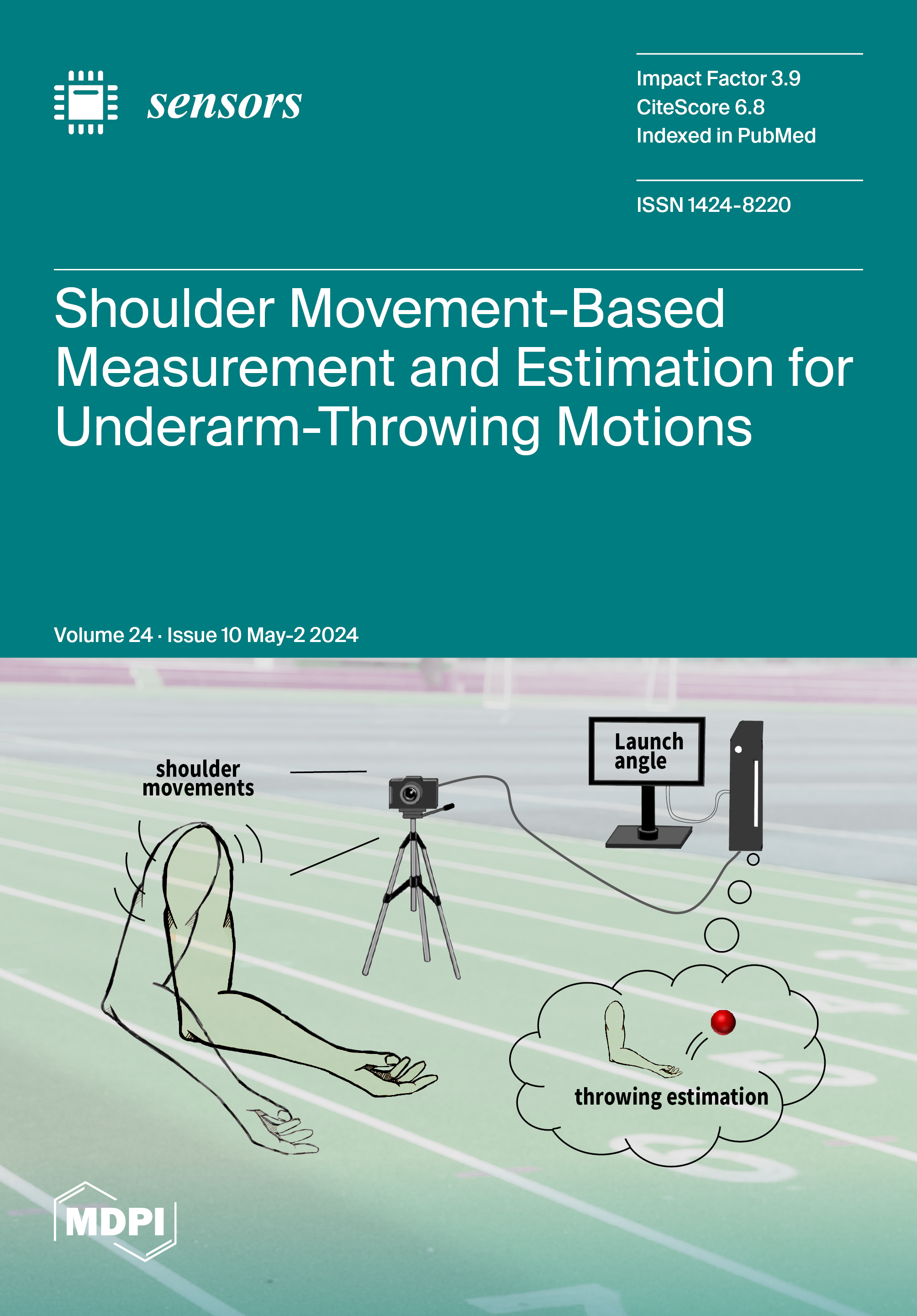 Index Air Quality Monitoring for Light and Active MobilityStefano Botticini , Elisabetta Comini , Salvatore Dello Iacono , Alessandra Flammini , Luigi Gaioni , Andrea Galliani , Luca Ghislotti, Paolo Lazzaroni , Valerio Re , Emiliano Sisinni , Matteo Verzeroli , and Dario ZappaSensors, Jan 2024Number: 10 Publisher: Multidisciplinary Digital Publishing Institute
Light and active mobility, as well as multimodal mobility, could significantly contribute to decarbonization. Air quality is a key parameter to monitor the environment in terms of health and leisure benefits. In a possible scenario, wearables and recharge stations could supply information about a distributed monitoring system of air quality. The availability of low-power, smart, low-cost, compact embedded systems, such as Arduino Nicla Sense ME, based on BME688 by Bosch, Reutlingen, Germany, and powered by suitable software tools, can provide the hardware to be easily integrated into wearables as well as in solar-powered EVSE (Electric Vehicle Supply Equipment) for scooters and e-bikes. In this way, each e-vehicle, bike, or EVSE can contribute to a distributed monitoring network providing real-time information about micro-climate and pollution. This work experimentally investigates the capability of the BME688 environmental sensor to provide useful and detailed information about air quality. Initial experimental results from measurements in non-controlled and controlled environments show that BME688 is suited to detect the human-perceived air quality. CO2 readout can also be significant for other gas (e.g., CO), while IAQ (Index for Air Quality, from 0 to 500) is heavily affected by relative humidity, and its significance below 250 is quite low for an outdoor uncontrolled environment.
@article{botticini_index_2024, title = {Index Air Quality Monitoring for Light and Active Mobility}, volume = {24}, copyright = {http://creativecommons.org/licenses/by/3.0/}, issn = {1424-8220}, url = {https://www.mdpi.com/1424-8220/24/10/3170}, doi = {10.3390/s24103170}, language = {en}, number = {10}, urldate = {2024-05-27}, journal = {Sensors}, author = {Botticini, Stefano and Comini, Elisabetta and Dello Iacono, Salvatore and Flammini, Alessandra and Gaioni, Luigi and Galliani, Andrea and Ghislotti, Luca and Lazzaroni, Paolo and Re, Valerio and Sisinni, Emiliano and Verzeroli, Matteo and Zappa, Dario}, month = jan, year = {2024}, note = {Number: 10 Publisher: Multidisciplinary Digital Publishing Institute}, keywords = {air quality index, light mobility, MOx sensors}, pages = {3170}, file = {Full Text PDF:files/263/Botticini et al. - 2024 - Index Air Quality Monitoring for Light and Active .pdf:application/pdf}, dimensions = {true} } -
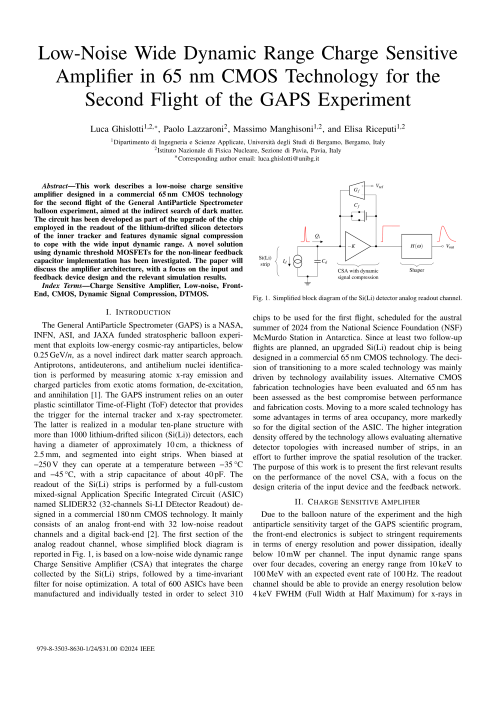 Low-Noise Wide Dynamic Range Charge Sensitive Amplifier in 65 nm CMOS Technology for the Second Flight of the GAPS ExperimentLuca Ghislotti, Paolo Lazzaroni , Massimo Manghisoni , and Elisa RiceputiIn 2024 19th Conference on Ph.D. Research in Microelectronics and Electronics (PRIME) , Jun 2024
This work describes a low-noise charge sensitive amplifier designed in a commercial 65nm CMOS technology for the second flight of the General AntiParticle Spectrometer balloon experiment, aimed at the indirect search of dark matter. The circuit has been developed as part of the upgrade of the chip employed in the readout of the lithium-drifted silicon detectors of the inner tracker and features dynamic signal compression to cope with the wide input dynamic range. A novel solution using dynamic threshold MOSFETs for the non-linear feedback capacitor implementation has been investigated. The paper will discuss the amplifier architecture, with a focus on the input and feedback device design and the relevant simulation results.
@inproceedings{ghislotti_low-noise_2024, title = {Low-Noise Wide Dynamic Range Charge Sensitive Amplifier in 65 nm CMOS Technology for the Second Flight of the GAPS Experiment}, url = {https://ieeexplore.ieee.org/document/10559720}, doi = {10.1109/PRIME61930.2024.10559720}, urldate = {2024-06-28}, booktitle = {2024 19th Conference on Ph.D. Research in Microelectronics and Electronics (PRIME)}, author = {Ghislotti, Luca and Lazzaroni, Paolo and Manghisoni, Massimo and Riceputi, Elisa}, month = jun, year = {2024}, keywords = {Capacitors, Charge Sensitive Amplifier, CMOS, CMOS technology, DTMOS, Dynamic Signal Compression, Feature extraction, Front-End, Low-noise, MOSFET, Power demand, Silicon, Simulation}, pages = {1–4}, dimensions = {true} } -
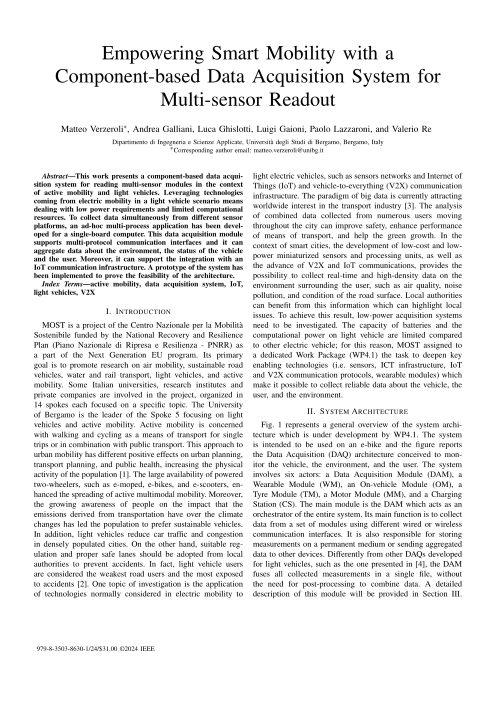 Empowering Smart Mobility with a Component-based Data Acquisition System for Multi-sensor ReadoutMatteo Verzeroli , Andrea Galliani , Luca Ghislotti, Luigi Gaioni , Paolo Lazzaroni , and Valerio ReIn 2024 19th Conference on Ph.D. Research in Microelectronics and Electronics (PRIME) , Jun 2024
This work presents a component-based data acquisition system for reading multi-sensor modules in the context of active mobility and light vehicles. Leveraging technologies coming from electric mobility in a light vehicle scenario means dealing with low power requirements and limited computational resources. To collect data simultaneously from different sensor platforms, an ad-hoc multi-process application has been developed for a single-board computer. This data acquisition module supports multi-protocol communication interfaces and it can aggregate data about the environment, the status of the vehicle and the user. Moreover, it can support the integration with an IoT communication infrastructure. A prototype of the system has been implemented to prove the feasibility of the architecture.
@inproceedings{verzeroli_empowering_2024, title = {Empowering Smart Mobility with a Component-based Data Acquisition System for Multi-sensor Readout}, url = {https://ieeexplore.ieee.org/document/10559671}, doi = {10.1109/PRIME61930.2024.10559671}, urldate = {2024-07-30}, booktitle = {2024 19th Conference on Ph.D. Research in Microelectronics and Electronics (PRIME)}, author = {Verzeroli, Matteo and Galliani, Andrea and Ghislotti, Luca and Gaioni, Luigi and Lazzaroni, Paolo and Re, Valerio}, month = jun, year = {2024}, keywords = {active mobility, Aggregates, Computer architecture, Data acquisition, data acquisition system, Data aggregation, IoT, light vehicles, Microelectronics, Prototypes, Reliability, V2X}, pages = {1–4}, dimensions = {true} } -
 Advancing Sustainable Mobility: A Data Acquisition System for Light Vehicles and Active MobilityMatteo Verzeroli , Luigi Gaioni , Andrea Galliani , Luca Ghislotti, Paolo Lazzaroni , and Valerio ReElectronics, Jan 2024Number: 21 Publisher: Multidisciplinary Digital Publishing Institute
Active mobility and light vehicles, such as e-bikes, are gaining increasing attention as sustainable transportation alternatives to internal combustion solutions. In this context, collecting comprehensive data on environmental conditions, vehicle performance, and user interaction is crucial for improving system efficiency and user experience. This paper presents a data acquisition system designed to collect data from multiple sensor platforms. The architecture is optimized to maintain low power consumption and operate within limited computational resources, making it suitable for real-time data acquisition on light vehicles. To achieve this, a data acquisition module was developed using a single-board computer integrated with a custom shield, which also captures data related to the assistance of an e-bike motor through a wireless interface. The paper provides an in-depth discussion of the architecture and software development, along with a detailed overview of the sensors used. A demonstrator was created to verify the system architecture idea and prove the potentialities of the system overall. The demonstrator has been qualified by professional and semi-professional riders in the framework of the Giro-E, a cyclist event which took place in May 2024, on the same roads of the Giro d’Italia. Finally, some preliminary analyses on the data acquired are provided to show the performance of the system, particularly in reconstructing the user behavior, the environmental parameters, and the type of road.
@article{verzeroli_advancing_2024, title = {Advancing Sustainable Mobility: A Data Acquisition System for Light Vehicles and Active Mobility}, volume = {13}, copyright = {http://creativecommons.org/licenses/by/3.0/}, issn = {2079-9292}, shorttitle = {Advancing Sustainable Mobility}, url = {https://www.mdpi.com/2079-9292/13/21/4249}, doi = {10.3390/electronics13214249}, language = {en}, number = {21}, urldate = {2024-10-30}, journal = {Electronics}, author = {Verzeroli, Matteo and Gaioni, Luigi and Galliani, Andrea and Ghislotti, Luca and Lazzaroni, Paolo and Re, Valerio}, month = jan, year = {2024}, note = {Number: 21 Publisher: Multidisciplinary Digital Publishing Institute}, keywords = {air quality index, light mobility, MOx sensors, low power, software architecture}, pages = {4249}, dimensions = {true} } -
 Integration and Calibration of the GAPS Antarctic Balloon PayloadRiccardo Munini , and GAPS CollaborationIn Proceedings of 38th International Cosmic Ray Conference — PoS(ICRC2023) , Sep 2024Conference Name: 38th International Cosmic Ray Conference
With its inaugural Antarctic long-duration balloon mission in December 2023, the General Antiparticle Spectrometer (GAPS) will become the first experiment optimized to detect cosmic-ray antinuclei below 0.25 GeV/n. Detection of a single antideuteron at this energy scale would be a smoking-gun signature of new physics such as dark matter. The GAPS program will also provide a precision antiproton spectrum in a previously unprobed low-energy range, as well as leading sensitivity to antihelium-3. This new parameter space is accessible thanks to a novel particle identification method based on exotic atom formation, de-excitation, and decay. The method provides a unique handle for the negatively-charged antinuclei, facilitating excellent rejection of the positive-nucleus background, and does not require a magnet, enabling a large sensitive area for rare events. The GAPS instrument is designed to provide excellent discrimination power for rare events within the power and mass constraints of a long-duration balloon. The time-of-flight, composed of 160 scintillator paddles, provides the system trigger as well as the GAPS energy scale. The 2.5 m3 tracker volume is instrumented with 1000 10-cm-diameter silicon sensors which serve as the target, X-ray spectrometer, and particle tracker. Together, a large-area radiator and an integrated oscillating heat pipe system cool the payload without a bulky cryostat. This contribution reports the integration and calibration of the GAPS science payload, including the performance of the sensitive detector subsystems, the cooling system, the power distribution, and data acquisition and onboard event processing.
@incollection{munini_integration_2024, title = {Integration and Calibration of the GAPS Antarctic Balloon Payload}, volume = {444}, url = {https://pos.sissa.it/444/180}, language = {en}, urldate = {2025-01-06}, booktitle = {Proceedings of 38th International Cosmic Ray Conference — PoS(ICRC2023)}, publisher = {SISSA Medialab}, author = {Munini, Riccardo and on behalf of the GAPS Collaboration}, month = sep, year = {2024}, doi = {10.22323/1.444.0180}, note = {Conference Name: 38th International Cosmic Ray Conference}, pages = {180}, dimensions = {true} } -
 The identification of the cosmic-ray light nuclei with the GAPS experimentRiccardo Munini , Alex Lenni , and GAPS CollaborationIn Proceedings of 38th International Cosmic Ray Conference — PoS(ICRC2023) , Sep 2024Conference Name: 38th International Cosmic Ray Conference
GAPS (General AntiParticle Spectrometer) is a balloon-borne large-acceptance experiment designed to detect low-energy (<0.25 GeV/n) cosmic-ray antinuclei during three 35-day Antarctic flights, the first of these planned for the 2024-2025 austral summer. The GAPS apparatus, currently in preparation for the first flight, consists of a tracker equipped with large-area lithium-drifted silicon detectors and surrounded by a large-acceptance time-of-flight system made of plastic scintillators. This design has been optimized to perform a novel antiparticle identification technique based on an antinucleus capture and the subsequent exotic atom formation and decay, allowing more active target material and a larger geometrical acceptance since no magnet is required. Although detecting the cosmic-ray antinuclei as an indirect dark-matter signature is the primary goal of GAPS, many low-energy cosmic-ray nuclei will also be recorded. Nuclei do not form exotic atoms in the GAPS detectors, and their detection is based on the measurements of the ionization energy depositions and the evaluation of the kinetic energy and the stopping depth relative to the measured velocity. An algorithm was developed to fit the slow-down of particles and antiparticles tracked inside the GAPS apparatus. The quantities fitted by this algorithm, together with the measured velocity and energy deposition information, allow the identification of protons, deuterons, and helium nuclei and the measurement of their spectra in a low-energy range (< 0.25 GeV/n). The results of this analysis, based on detailed Monte Carlo simulation studies, will be presented in this contribution.
@incollection{munini_identification_2024, title = {The identification of the cosmic-ray light nuclei with the GAPS experiment}, volume = {444}, url = {https://pos.sissa.it/444/179}, language = {en}, urldate = {2025-01-06}, booktitle = {Proceedings of 38th International Cosmic Ray Conference — PoS(ICRC2023)}, publisher = {SISSA Medialab}, author = {Munini, Riccardo and Lenni, Alex and on behalf of the GAPS Collaboration}, month = sep, year = {2024}, doi = {10.22323/1.444.0179}, note = {Conference Name: 38th International Cosmic Ray Conference}, pages = {179}, dimensions = {true} } -
 The GAPS Time-of-Flight DetectorSydney Nicole Feldman , T. Aramaki , M. Boezio , S. E. Boggs , V. Bonvicini , G. Bridges , D. Campana , W. W. Craig , P. Doetinchem , E. Everson , L. Fabris , H. Fuke , F. Gahbauer , C. Gerrity , L. Ghislotti, C. J. Hailey , T. Hayashi , A. Kawachi , M. Kozai , M. Law , P. Lazzaroni , A. Lenni , A. Lowell , M. Manghisoni , N. Marcelli , K. Mizukoshi , E. Mocchiutti , B. Mochizuki , S. a. I. Mognet , K. Munakata , R. Munini , S. Okazaki , J. Olson , R. A. Ong , G. Osteria , K. Perez , F. Perfetto , S. Quinn , V. Re , E. Riceputi , B. Roach , F. Rogers , J. L. Ryan , N. Saffold , V. Scotti , Y. Shimizu , K. Shutt , R. Sparvoli , A. Stoessl , A. Tiberio , E. Vannuccini , M. Xiao , M. Yamatani , K. Yee , T. Yoshida , G. Zampa , J. Zeng , and J. ZweerinkIn Proceedings of 38th International Cosmic Ray Conference — PoS(ICRC2023) , Sep 2024Conference Name: 38th International Cosmic Ray Conference
The General Antiparticle Spectrometer (GAPS) Antarctic long duration balloon mission is scheduled for launch during the austral summer of 2024-25. Its novel detection technique, based on exotic atom formation, excitation, and decay, is specifically designed for the detection of slow moving cosmic antiprotons and antideuterons. Such antinuclei are predicted by a wide variety of allowed dark matter models, as well as other astrophysical theories like primordial black holes. There are two main components of the GAPS instrument: a large-area tracker and a surrounding time-of-flight system (TOF). The combination of these two systems allows GAPS to effectively differentiate between species of negatively-charged antinuclei and determine the energy deposition, velocity, and trajectory of particles interacting with the detector. This contribution will focus on the TOF, which determines the velocity of the incoming antiparticle and provides the trigger to the experiment. We will give an overview of the TOF detector, an explanation of relevant electronics, and a report on its construction and preliminary performance. The TOF is composed of 160 thin plastic scintillator paddles ranging in length from 1.5 to 1.8 meters. At each paddle end, signals from six silicon photomultipliers are combined to produce two copies of the resulting waveform: one to form the trigger and one for data readout. This design is optimized for low mass and fast data acquisition while still maintaining good light collection.
@incollection{feldman_gaps_2024, title = {The GAPS Time-of-Flight Detector}, volume = {444}, url = {https://pos.sissa.it/444/120}, language = {en}, urldate = {2025-01-06}, booktitle = {Proceedings of 38th International Cosmic Ray Conference — PoS(ICRC2023)}, publisher = {SISSA Medialab}, author = {Feldman, Sydney Nicole and Aramaki, T. and Boezio, M. and Boggs, S. E. and Bonvicini, V. and Bridges, G. and Campana, D. and Craig, W. W. and von Doetinchem, P. and Everson, E. and Fabris, L. and Fuke, H. and Gahbauer, F. and Gerrity, C. and Ghislotti, L. and Hailey, C. J. and Hayashi, T. and Kawachi, A. and Kozai, M. and Law, M. and Lazzaroni, P. and Lenni, A. and Lowell, A. and Manghisoni, M. and Marcelli, N. and Mizukoshi, K. and Mocchiutti, E. and Mochizuki, B. and Mognet, S. a. I. and Munakata, K. and Munini, R. and Okazaki, S. and Olson, J. and Ong, R. A. and Osteria, G. and Perez, K. and Perfetto, F. and Quinn, S. and Re, V. and Riceputi, E. and Roach, B. and Rogers, F. and Ryan, J. L. and Saffold, N. and Scotti, V. and Shimizu, Y. and Shutt, K. and Sparvoli, R. and Stoessl, A. and Tiberio, A. and Vannuccini, E. and Xiao, M. and Yamatani, M. and Yee, K. and Yoshida, T. and Zampa, G. and Zeng, J. and Zweerink, J.}, month = sep, year = {2024}, doi = {10.22323/1.444.0120}, note = {Conference Name: 38th International Cosmic Ray Conference}, pages = {120}, dimensions = {true} } -
 The GAPS experiment - a search for light cosmic ray antinucleiAchim Stoessl , and GAPS CollaborationIn Proceedings of 38th International Cosmic Ray Conference — PoS(ICRC2023) , Sep 2024Conference Name: 38th International Cosmic Ray Conference
The General Anti Particle Spectrometer (GAPS) is a balloon-borne cosmic-ray experiment which is currently in its last phase of construction, undergoing system testing, and scheduled for a long-duration balloon flight from McMurdo Station in the Antarctic in December 2024. Its primary scientific goal is the search for light antinuclei in cosmic rays at kinetic energies below 0.25 GeV/n. This energy region is especially of interest for beyond-the-standard model dark matter searches and is still mostly uncharted. Searches for light antimatter nuclei with energies below 0.25 GeV/n are a novel approach to the search for dark matter because wide range of dark matter models proposes annihilation or decay into matter-antimatter pairs. GAPS will yield unprecedented sensitivity to low-energy antideuterons and will measure the low-energy antiproton spectrum with high statistics and precision. To reach the required sensitivity, the GAPS detector incorporates a new approach for antimatter detection, utilizing a tracker with custom, lithium-drifted silicon detectors, designed to measure the X-ray cascade expected from antimatter capture and charged particles from the subsequent annihilation. It also utilizes a fast time-of-flight system, allowing for a high-precision beta measurement. This proceeding highlights GAPS scientific goals.
@incollection{stoessl_gaps_2024, title = {The GAPS experiment - a search for light cosmic ray antinuclei}, volume = {444}, url = {https://pos.sissa.it/444/1440}, language = {en}, urldate = {2025-01-06}, booktitle = {Proceedings of 38th International Cosmic Ray Conference — PoS(ICRC2023)}, publisher = {SISSA Medialab}, author = {Stoessl, Achim and on behalf of the GAPS Collaboration}, month = sep, year = {2024}, doi = {10.22323/1.444.1440}, note = {Conference Name: 38th International Cosmic Ray Conference}, pages = {1440}, dimensions = {true} } -
 The identification of the cosmic-ray light nuclei with the GAPS experimentRiccardo Munini , Alex Lenni , and GAPS CollaborationIn Proceedings of 38th International Cosmic Ray Conference — PoS(ICRC2023) , Sep 2024
GAPS (General AntiParticle Spectrometer) is a balloon-borne large-acceptance experiment designed to detect low-energy (<0.25 GeV/n) cosmic-ray antinuclei during three 35-day Antarctic flights, the first of these planned for the 2024-2025 austral summer. The GAPS apparatus, currently in preparation for the first flight, consists of a tracker equipped with large-area lithium-drifted silicon detectors and surrounded by a large-acceptance time-of-flight system made of plastic scintillators. This design has been optimized to perform a novel antiparticle identification technique based on an antinucleus capture and the subsequent exotic atom formation and decay, allowing more active target material and a larger geometrical acceptance since no magnet is required. Although detecting the cosmic-ray antinuclei as an indirect dark-matter signature is the primary goal of GAPS, many low-energy cosmic-ray nuclei will also be recorded. Nuclei do not form exotic atoms in the GAPS detectors, and their detection is based on the measurements of the ionization energy depositions and the evaluation of the kinetic energy and the stopping depth relative to the measured velocity. An algorithm was developed to fit the slowdown of particles and antiparticles tracked inside the GAPS apparatus. The quantities fitted by this algorithm, together with the measured velocity and energy deposition information, allow the identification of protons, deuterons, and helium nuclei and the measurement of their spectra in a low-energy range (<0.25 GeV/n). The results of this analysis, based on detailed Monte Carlo simulation studies, will be presented in this contribution.
@incollection{munini_identification_2024_alternative,
  title = {The identification of the cosmic-ray light nuclei with the GAPS experiment},
  booktitle = {Proceedings of 38th International Cosmic Ray Conference — PoS(ICRC2023)},
  author = {Munini, Riccardo and Lenni, Alex and on behalf of the GAPS Collaboration},
  year = {2024},
  month = sep,
  volume = {444},
  pages = {179},
  publisher = {SISSA Medialab},
  doi = {10.22323/1.444.0179},
  urldate = {2025-01-06},
  language = {en},
  dimensions = {true}
}


2023
-
 A mixed-signal processor for X-ray spectrometry and tracking in the GAPS experimentValerio Re , Luca Ghislotti, Paolo Lazzaroni , Massimo Manghisoni , Elisa Riceputi , Lodovico Ratti , Mirko Boezio , Gianluigi Zampa , and Lorenzo FabrisNuclear Instruments and Methods in Physics Research Section A: Accelerators, Spectrometers, Detectors and Associated Equipment, Sep 2023Publisher: Elsevier
@article{re_mixed-signal_2023, title = {A mixed-signal processor for X-ray spectrometry and tracking in the GAPS experiment}, volume = {1045}, url = {https://www.sciencedirect.com/science/article/pii/S0168900222009093}, urldate = {2024-03-12}, journal = {Nuclear Instruments and Methods in Physics Research Section A: Accelerators, Spectrometers, Detectors and Associated Equipment}, author = {Re, Valerio and Ghislotti, Luca and Lazzaroni, Paolo and Manghisoni, Massimo and Riceputi, Elisa and Ratti, Lodovico and Boezio, Mirko and Zampa, Gianluigi and Fabris, Lorenzo}, year = {2023}, note = {Publisher: Elsevier}, pages = {167617}, doi = {10.1016/j.nima.2022.167617}, dimensions = {true} } -
 The 32 Analog Channels Readout for the Long-Flight GAPS Balloon Experiment Tracking SystemE. Riceputi , M. Boezio , L. Fabris , L. Ghislotti, P. Lazzaroni , M. Manghisoni , L. Ratti , V. Re , and G. ZampaIn Proceedings of SIE 2022 , Sep 2023Series Title: Lecture Notes in Electrical Engineering
@incollection{cocorullo_32_2023, address = {Cham}, title = {The 32 Analog Channels Readout for the Long-Flight GAPS Balloon Experiment Tracking System}, volume = {1005}, isbn = {978-3-031-26065-0 978-3-031-26066-7}, url = {https://link.springer.com/10.1007/978-3-031-26066-7_5}, language = {en}, urldate = {2024-03-12}, booktitle = {Proceedings of SIE 2022}, publisher = {Springer Nature Switzerland}, author = {Riceputi, E. and Boezio, M. and Fabris, L. and Ghislotti, L. and Lazzaroni, P. and Manghisoni, M. and Ratti, L. and Re, V. and Zampa, G.}, editor = {Cocorullo, Giuseppe and Crupi, Felice and Limiti, Ernesto}, year = {2023}, doi = {10.1007/978-3-031-26066-7_5}, note = {Series Title: Lecture Notes in Electrical Engineering}, pages = {27–32}, dimensions = {true} } -
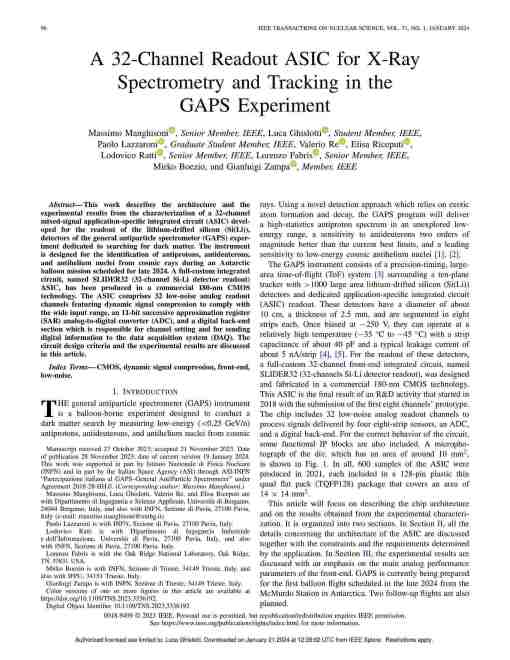 A 32-channels readout ASIC for X-ray spectrometry and tracking in the GAPS experimentMassimo Manghisoni , Luca Ghislotti, Paolo Lazzaroni , Valerio Re , Elisa Riceputi , Lodovico Ratti , Lorenzo Fabris , Mirko Boezio , and Gianluigi ZampaIEEE Transactions on Nuclear Science, Sep 2023Publisher: IEEE
@article{manghisoni_32-channels_2023, title = {A 32-channels readout ASIC for X-ray spectrometry and tracking in the GAPS experiment}, url = {https://ieeexplore.ieee.org/abstract/document/10330133/}, urldate = {2024-03-12}, journal = {IEEE Transactions on Nuclear Science}, author = {Manghisoni, Massimo and Ghislotti, Luca and Lazzaroni, Paolo and Re, Valerio and Riceputi, Elisa and Ratti, Lodovico and Fabris, Lorenzo and Boezio, Mirko and Zampa, Gianluigi}, year = {2023}, note = {Publisher: IEEE}, doi = {10.1109/TNS.2023.3336192}, dimensions = {true} } -
 GAPS contributions to the 38th International Cosmic Ray Conference (Nagoya 2023)T. Aramaki , M. Boezio , S. E. Boggs , V. Bonvicini , G. Bridges , D. Campana , W. W. Craig , P. Doetinchem , E. Everson , L. Fabris , S. Feldman , H. Fuke , F. Gahbauer , C. Gerrity , L. Ghislotti, C. J. Hailey , T. Hayashi , A. Kawachi , M. Kozai , P. Lazzaroni , M. Law , A. Lenni , A. Lowell , M. Manghisoni , N. Marcelli , K. Mizukoshi , E. Mocchiutti , B. Mochizuki , S. A. I. Mognet , K. Munakata , R. Munini , S. Okazaki , J. Olson , R. A. Ong , G. Osteria , K. Perez , F. Perfetto , S. Quinn , V. Re , E. Riceputi , B. Roach , F. Rogers , J. L. Ryan , N. Saffold , V. Scotti , Y. Shimizu , K. Shutt , R. Sparvoli , A. Stoessl , A. Tiberio , E. Vannuccini , M. Xiao , M. Yamatani , K. Yee , T. Yoshida , G. Zampa , J. Zeng , and J. ZweerinkOct 2023arXiv:2310.10181 [astro-ph]
Compilation of papers presented by the GAPS Collaboration at the 38th International Cosmic Ray Conference (ICRC), held July 26 through August 3, 2023 in Nagoya, Japan.
@misc{aramaki_gaps_2023, title = {GAPS contributions to the 38th International Cosmic Ray Conference (Nagoya 2023)}, url = {http://arxiv.org/abs/2310.10181}, urldate = {2024-03-12}, publisher = {arXiv}, author = {Aramaki, T. and Boezio, M. and Boggs, S. E. and Bonvicini, V. and Bridges, G. and Campana, D. and Craig, W. W. and von Doetinchem, P. and Everson, E. and Fabris, L. and Feldman, S. and Fuke, H. and Gahbauer, F. and Gerrity, C. and Ghislotti, L. and Hailey, C. J. and Hayashi, T. and Kawachi, A. and Kozai, M. and Lazzaroni, P. and Law, M. and Lenni, A. and Lowell, A. and Manghisoni, M. and Marcelli, N. and Mizukoshi, K. and Mocchiutti, E. and Mochizuki, B. and Mognet, S. A. I. and Munakata, K. and Munini, R. and Okazaki, S. and Olson, J. and Ong, R. A. and Osteria, G. and Perez, K. and Perfetto, F. and Quinn, S. and Re, V. and Riceputi, E. and Roach, B. and Rogers, F. and Ryan, J. L. and Saffold, N. and Scotti, V. and Shimizu, Y. and Shutt, K. and Sparvoli, R. and Stoessl, A. and Tiberio, A. and Vannuccini, E. and Xiao, M. and Yamatani, M. and Yee, K. and Yoshida, T. and Zampa, G. and Zeng, J. and Zweerink, J.}, month = oct, year = {2023}, note = {arXiv:2310.10181 [astro-ph]}, keywords = {Astrophysics - High Energy Astrophysical Phenomena, Astrophysics - Instrumentation and Methods for Astrophysics}, eprint = {2310.10181}, } -
 Experimental results from the characterization of a 32-channels mixed-signal processor for the GAPS experimentE. Riceputi , M. Manghisoni , V. Re , L. Ghislotti, P. Lazzaroni , L. Ratti , L. Fabris , M. Boezio , G. Zampa , and M. XiaoIn 2023 IEEE Nuclear Science Symposium, Medical Imaging Conference and International Symposium on Room-Temperature Semiconductor Detectors (NSS MIC RTSD) , Oct 2023
@inproceedings{riceputi_experimental_2023, title = {Experimental results from the characterization of a 32-channels mixed-signal processor for the GAPS experiment}, url = {https://ieeexplore.ieee.org/abstract/document/10338321/}, urldate = {2024-03-12}, booktitle = {2023 IEEE Nuclear Science Symposium, Medical Imaging Conference and International Symposium on Room-Temperature Semiconductor Detectors (NSS MIC RTSD)}, publisher = {IEEE}, author = {Riceputi, E. and Manghisoni, M. and Re, V. and Ghislotti, L. and Lazzaroni, P. and Ratti, L. and Fabris, L. and Boezio, M. and Zampa, G. and Xiao, M.}, year = {2023}, pages = {1–1}, }


